

Henna With Jenna: Exploring Her Indo-Caribbean Identity Through Henna

Edited by: Shivane Chandool & Raiesa Ali
Growing up, I had a lot of exposure to my Caribbean identity through food, music (soca, reggae, dancehall and calypso with some chutney!) and language. However, I was less exposed to my Indian identity. The first [time] I ever had my henna was at a school fair. I remember leaving class early so I could be the first person to have mine done, and doing whatever I could to preserve the stain for as long as I could.
Since then I’ve absolutely loved henna, and it meant a lot to me because of how pretty the designs are and how there are different styles representing different cultures. It gave me such pride for my culture at a young age. Henna connects me to my Indian roots, especially to my ancestors–my great-grandmother in particular, who often told stories of working in plantations alongside her parents, rain or shine, starting at 4am and working until sunset. She was the daughter of indentured workers from India, who journeyed to the Caribbean for a better life. I often use a lot of Indian motifs, such as lotuses, as a way to honor those who came before me.
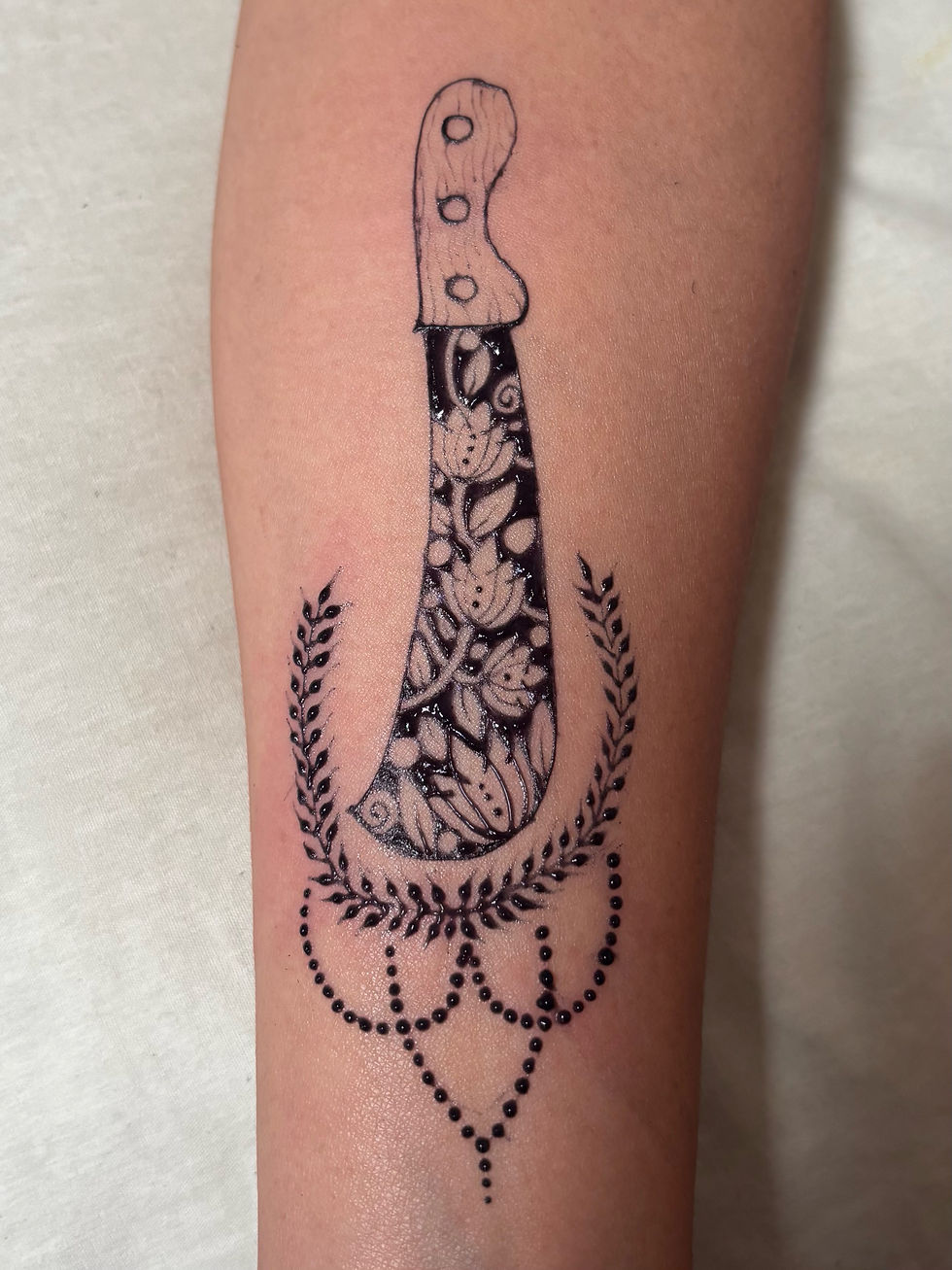
I preserve culture through symbolism: water lilies representing the national flower of Guyana, leaves and vines to represent the rich biodiversity, and including the outline of Guyana in my designs. Every element of my work is symbolic. Beyond my designs, I am using my platform to connect and raise awareness of Indo-Caribbean history. Many people have enjoyed my posts and some have even shared their own personal stories, which creates a really lovely sense of togetherness and community.
I collaborated with a small business for a stall they were doing and a customer wanted to have her henna done. While doing her design, she talked about how she rejected her identity for a long time as a child. As an adult, she is slowly starting to embrace it - with the first step being a henna design with me. That really stayed with me, because it reminded me that henna can be so much more than something visual. It can be a way for someone to reconnect with themselves and their culture. Being part of that moment felt incredibly special, and it’s something I carry with me in the work I do.

Process + Mindset
I often find myself thinking about identity, where I come from, and the journey of my ancestors when I create. That connection is always there in the background. At the same time, I’m holding space for the person I’m creating for. I think about what this moment means to them - whether it’s joy, celebration, healing, or even rediscovery - and I try to let that guide the flow of the design.
Florals are a big one for me as they represent growth, beauty, and femininity, but also softness and resilience. I love how they can be adapted in so many ways while still holding that core symbolism. I’m also drawn to vines and flowing patterns, especially because of how they move across the skin. They tend to symbolize connection and journey, which resonates with my personal growth and generational stories. Finally, I like building complex patterns by repeating elements - whether its chains, lines, vines or humps. It represents the complexity of stories; each story is unique, spans across multiple generations, and is multilayered.

I absolutely love doing traditional designs, however, I wanted to be more creatively expressive. I have always loved tattoos and started to gravitate towards tattoo style designs. I use henna as a method of personal expression, and I do enjoy giving myself a ‘tattoo’ every couple weeks. The beauty of this is that I can change the design whenever I like. I may do butterflies one week, then roses the next.
If my designs are tattoo-style then I feel more connected to my present self as these are often an expression of my own tastes or my client’s tastes. However when I create traditional designs I feel connected to my ancestry and I incorporate certain motifs to represent this. Even the act of doing a traditional design connects me; it feels like I’m mirroring an act my ancestors once did.

If I’m feeling calm and grounded, my work tends to be more intricate and precise, with a steady rhythm to it. If I’m feeling more expressive, I lean into bolder patterns, stronger movement, and more confident, fluid line work. My surroundings play a role too. Being around people, especially in community or cultural spaces, feels really energizing to me and reminds me why I do what I do. This often translates into more intentional, story-driven designs.
While the basic traditional elements of my designs will always be present, I like to play around with scale, spacing, and flow to create something that feels both rooted and modern. I draw a lot of inspiration from traditional motifs, and I like to reinterpret them, whether that’s simplifying certain patterns, exaggerating others, or incorporating negative space to give the design a more contemporary feel. For me, it’s about respecting the cultural significance of henna while also allowing room for individuality and self-expression. Each design becomes a balance between honoring tradition and creating something unique to the person wearing it.

Today + Beyond
I have a positive relationship with henna currently and I regularly do my own henna. I’ve also learned to do it on both of my hands, and I’m happy with the quality of work I produce. However, when I first started, my relationship with henna was very different. I was still experimenting with different styles and techniques, and exploring my own interpretation of designs. With practice over 3 years, this evolved. The quality of my designs improved. At this point, I decided to launch HennaWithJenna and I’ve grown ever since.
I like to sit down with my clients and understand their culture before I start their henna. I’m a versatile artist and can do many different styles - Arabic, Indian, and African, to name a few. I like to ensure my designs are personal to my client and incorporate elements such as their culture, pets, names of loved ones and even football teams! This allows beautifully for identity and a design unique specifically to that person. Once I learn about my client’s heritage, if they’re okay with sharing that with me, I make sure this is reflected in their design. I think henna is a beautiful way to express your identity artistically, and I love designs that reflect who you are as a person!

For a long time, there was a lack of representation in mainstream media and music [of our culture]. I didn’t always see our culture, our traditions, or our art reflected in the spaces around me. Because of that, I’ve come to value identity so much more deeply. Henna, for me, isn’t just about creating something beautiful: it’s about reclaiming and celebrating that identity. It’s about making space for culture to be seen, appreciated, and carried forward. That’s why I make a conscious effort to incorporate elements of identity into every design I create, no matter how big or small. Whether it’s subtle symbolism or more traditional influences, it’s important to me that my clients feel connected to something meaningful when they wear my work.
Recently, I have felt a responsibility to represent the Indo-Caribbean community in every way and I want to reflect as many perspectives as possible. As my platform grows, I want my identity to be central to my designs, to raise awareness about Indo-Caribbean history and contribute to its preservation. I am proud of my culture and want to share it with as many people as possible.
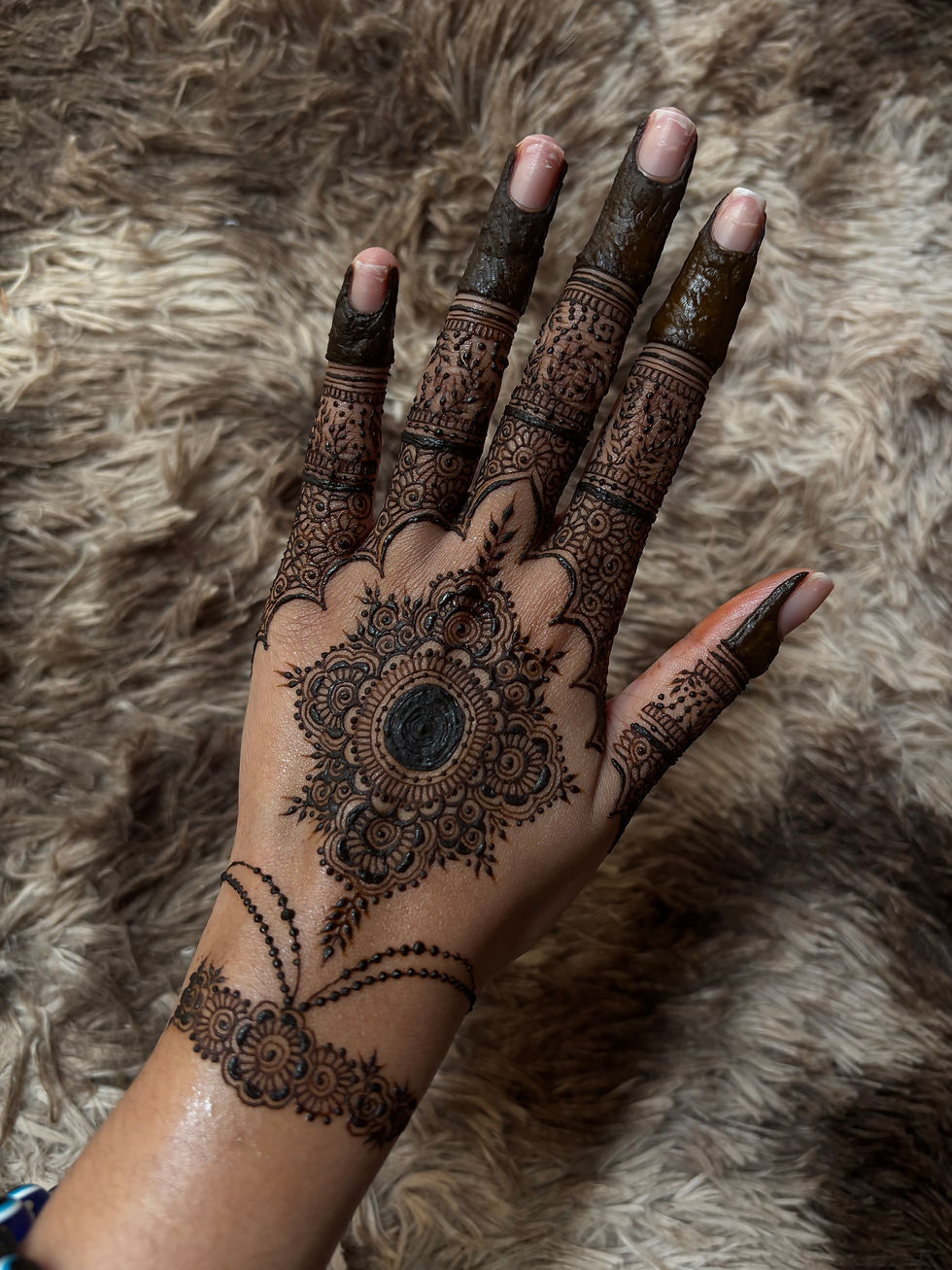
Through the styles I’m drawn to and the way I interpret traditional elements, I’m expressing my identity as an Indo-Caribbean woman. Choices such as placement and length impact the storytelling aspect of my work. Even small choices, like how complex or minimal a design is, the motifs I include, or how it moves across the skin can represent emotion, memory, or intention. So each piece becomes more than just art; it becomes a personal and cultural story, held and shared through the body.
To me, carrying Indo-Caribbean traditions in modern spaces means refusing to confine my culture to specific occasions or settings. It’s about letting it exist freely in everyday life, rather than only being seen as something for weddings or religious celebrations. I wear henna everyday. It turns something that’s often seen as “traditional” into something visible and present in spaces where it isn’t always represented. It becomes a quiet form of self expression while making a statement for me. Growing up, there wasn’t always much representation of Indo-Caribbean culture in mainstream spaces, so now I consciously choose to take up space with henna.

I see henna as spiritual, ritualistic, and artistic. It’s ritualistic in the way it’s tied to important moments, especially before weddings. It’s more than decoration; it marks a transition, a celebration, and a shared experience in an environment surrounded by loved ones. At the same time, henna is a form of artistic self-expression. Every design I create allows me to experiment, tell a story, and reflect both my style and the individuality of the person wearing it. No two designs are ever the same and that freedom is something I really value. Beyond that, it’s deeply spiritual for me. When I practice henna, I feel connected to my ancestors who were indentured from India to Guyana. It’s a quiet but powerful way of honoring where I come from, especially knowing the history and displacement behind that journey. Carrying on this tradition feels like keeping a part of them alive, and that connection is something I hold very close.

It means the world when other Indo-Caribbean women see themselves in my work. Growing up, I never saw myself in anything - not in the media, music or art. This absence really stayed with me. So to now be in a position where I can represent Indo-Caribbean women, especially Guyanese women, through my work feels incredibly meaningful. I can see myself in them, and they can see themselves in my work. As I continue to grow, representing Guyana will remain at the forefront of my work, always.
I have not had an Indo-Caribbean client (yet!) but I am currently in the process of collaborating with many other Indo-Caribbean businesses, which I am excited about! Elements of Indo-Caribbean culture still inspire my designs, especially through bold flowers and lines, storytelling, and symbolism. I’m drawn to the richness of traditional patterns, the vibrancy of celebrations, and the way our heritage is expressed visually across generations.
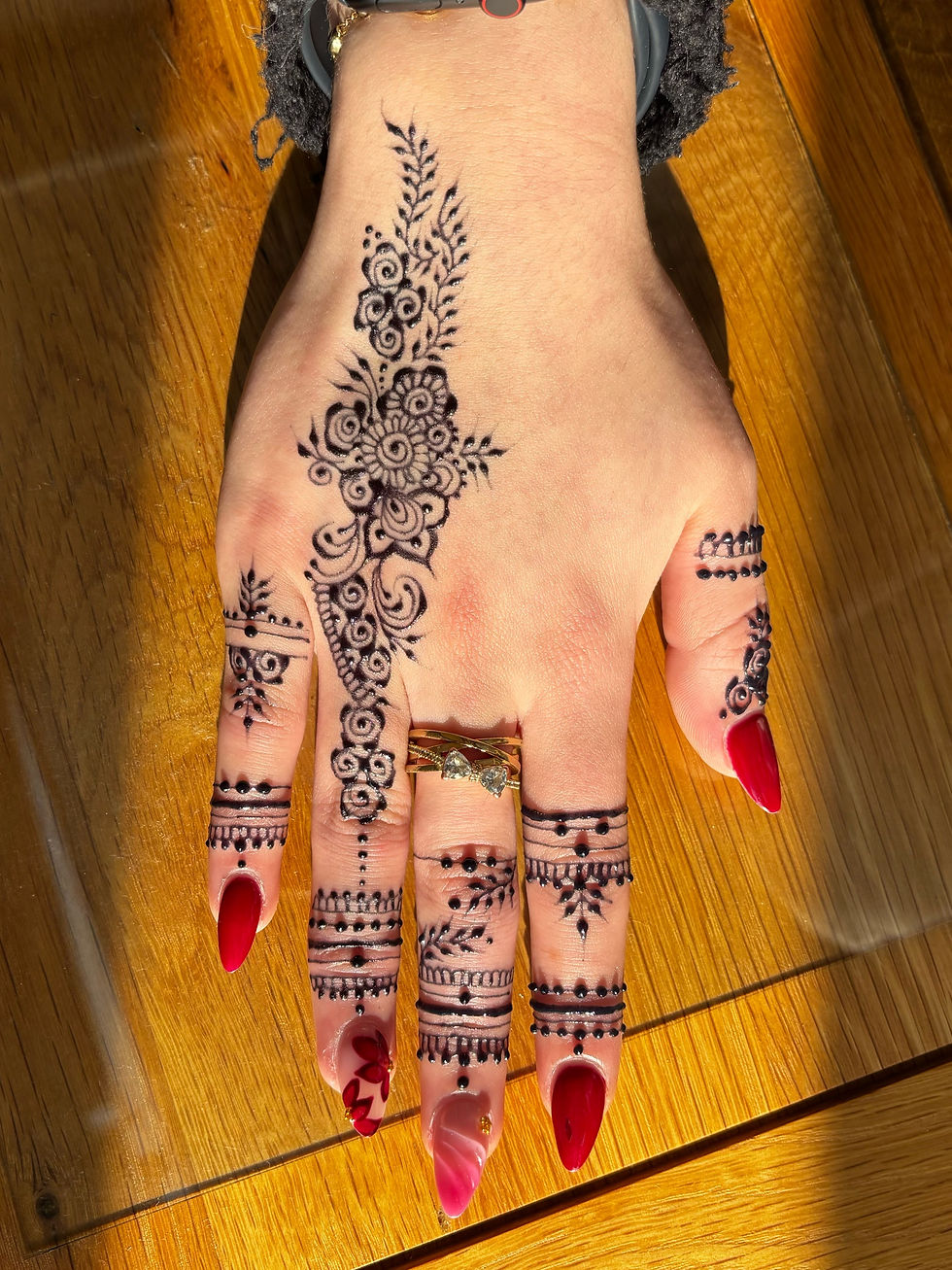
I hope my work inspires younger generations to explore their culture and take a deeper interest in their own family history. For a lot of us in the diaspora, those stories can feel distant or even lost, so I want my work to be a reminder that there’s so much value in reconnecting with where we come from. If someone sees my work and feels encouraged to ask questions, learn about their roots, or even start building their own family tree, that means everything to me. It’s about sparking that curiosity and helping younger generations feel proud of their identity, rather than disconnected from it.


Comments