

Finding a Dictionary of Caribbean English

By: Amelia Seepersaud
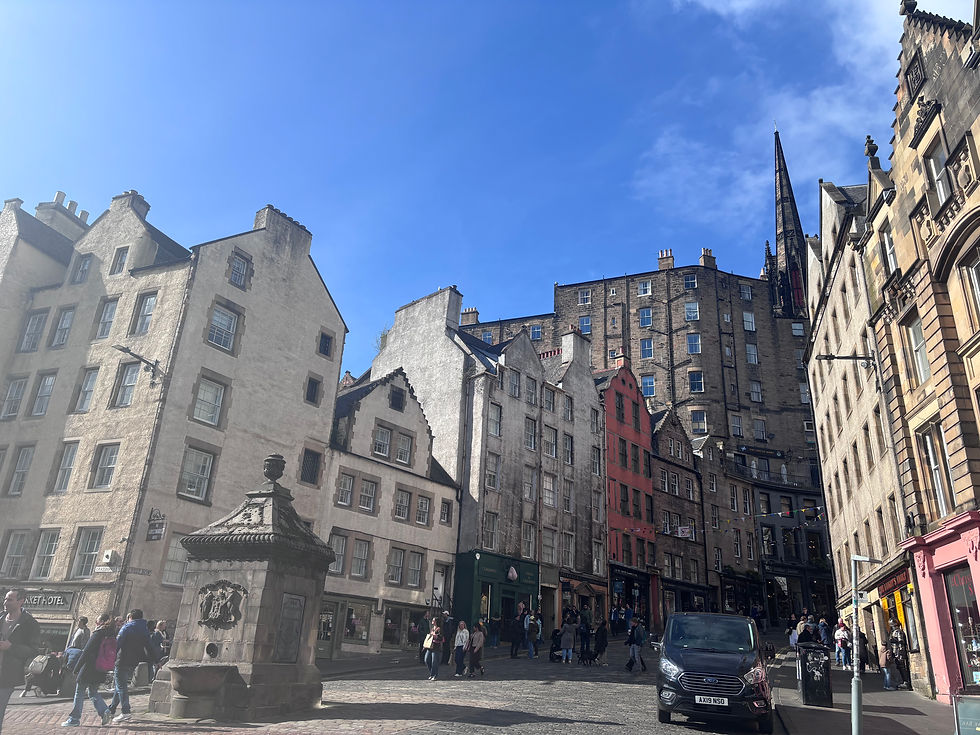
This April, I took a short, three-day trip to Edinburgh, Scotland. I quickly discovered that Edinburgh was a good city for wandering. And wander I did, as I explored the city’s nooks and crannies. On my first day in the city, I happened upon an antiquarian bookshop, tucked away at the bottom of a staircase. The shelves of the shop were filled with unique and well-loved books. As I browsed, one title stood out to me, “Dictionary of Caribbean English
Usage” by Richard Allsopp.
I pulled the dictionary from the shelf, feeling the weight of it in my hands, and simply stared at it. Words like “Phagwa”, “eye-pass”, “Tobago”, and “Georgetown”, decorated the cover. My eyes grazed over the word “Demerara”, and I smiled thinking of how my dad often mispronounces the name of the region as Demwara. I gingerly opened the book, as if it contained ancient treasures within its pages. The inside cover sported a map centered on the Caribbean Sea, highlighting many of the island and landlocked nations that comprise the West Indies. I flipped through the pages, racking my mind to think of Guyanese words and phrases often thrown around at home that I could search for. Amongst the dictionary’s contents, I found definitions of words like “botheration”, “back-dam”, “hard-ears”, etc. I turned to my friends animatedly explaining what words like “eye-pass” meant and how to use it and they encouraged me to get the dictionary after seeing how meaningful it was to me.
The book was being sold for barely a fraction of the price it would go for if I were to buy it online. It seemed like the kind of find that I couldn’t leave behind. When I purchased it, I expressed to the shopkeeper how cool I thought it was that a book like this exists as I have Caribbean heritage myself. He looked at the book like he was seeing it for the first time. This book, this dictionary, had been in this shop for an indeterminate amount of time and it seems no one had ever paid it much mind. It was likely viewed by anyone who would give it a glance as a deep dive into a niche academic subject.

But, to me it was not just a niche academic inquiry. It was a story of culture, and the potential legitimization of Caribbean ways of speaking. I could only imagine that Richard Allsopp, the Guyanese-born professor who authored this dictionary and spent his life studying linguistics and Caribbean lexicographies, was motivated by a similar desire to contextualise and legitimize the way our people express themselves through language.
Growing up, Guyanese Creole was always described as “broken english”, a very common way to refer to the patois and creole languages of the West Indies. Our people often have this belief that Guyanese English is not “proper” English. I always took issue with this but, never really knew how to refute such an assertion. The term “broken” implied that something was defective and in need of fixing. How could the way an entire nation of people chose to express themselves be defective?
Last September, when I moved to Dublin, where I have spent the past year completing my masters degree, my parents came with me to help with the move. After just one week in Ireland, being exposed to different Irish accents, my parents and I noted some similarities between these accents and the one my parents grew up speaking in. A couple months into the fall semester, I had met an Irish person from a different county, and we got to talking about the different Irish accents and he told me that Irish people from his area use the word “bai” instead of “boy”. My eyes widened as I responded, “No way, Guyanese people say ‘bhai’, too!”
These experiences reaffirmed for me and allowed my parents to consider the concept that our English was not “broken”, but merely a product of a complex historical and cultural web of migration, oppression, and cultural fusion. Much like us, the Irish were on the receiving end of British oppression and colonialism. My family and I enjoyed experiencing a country in Europe with a culture and energy that we could find some commonality with.

I am not a linguist, so I have no way of asserting whether these similarities in language are a product of similar linguistic origins or simply two different accents that happen to pronounce specific words in the same way. Regardless, these similarities demonstrate how common these divergences from “proper” English are, and encourage the notion that there is no specific way a language ought to be. For me, finding this book helped to legitimize the creole and patois languages commonly spoken in the Caribbean as its own entity. An entity, that is of equal cultural importance to what is considered more “proper” and “professional” manners of speaking.
Finding a book researched and published by a Guyanese academic in Edinburgh of all places, across the ocean, so far away from my home in New York, made it feel as though this book was waiting on that shelf for me. It was waiting for a Guyanese person to walk into that shop and give it a home where its purpose and contents would be appreciated. It reminded me that traveling is a privilege and an opportunity to broaden our horizons not only in terms of expanding our understanding of the world, but also in discovering new things about ourselves and our own stories.
Since buying the dictionary, I have shared it with several family members. We sit together, trying to think of words we use or have heard others use, and search through its pages to see if it's there. Oftentimes finding these words are accompanied by stories of moments they have been used within the family or an animated discussion of the correct intonation to invoke certain words and phrases with. It has continued to create opportunities for the exploration of our cultural expression.

This book was originally published in 1996, yet, no one I have shown it to knew of its existence. But, everyone I have shared it with thus far has been excited and happy to learn there is a book documenting and giving recognition to Caribbean English as its own living, breathing language. This book affirms forms of linguistic expression often deemed “broken” and it offers an opportunity for conversation and connections across generations and across Caribbean diasporas through the exploration of the words and phrases it immortalises.


Comments